



In this article, we explain how a lithium-ion cell is constructed and what chemical processes take place during charging and discharging.
Our batteries contain lithium-ion cells, which are rechargeable electrochemical storage cells. The special feature of this cell is that lithium ions can move freely between two electrodes, thereby enabling electrical energy to be stored and released.
This process can be repeated several hundred to a thousand times before the cell’s ageing becomes noticeable.
The so-called ‘Corepack’, which is the actual energy storage unit of a battery, consists of several of these lithium-ion cells. Our batteries contain up to 65 of them.
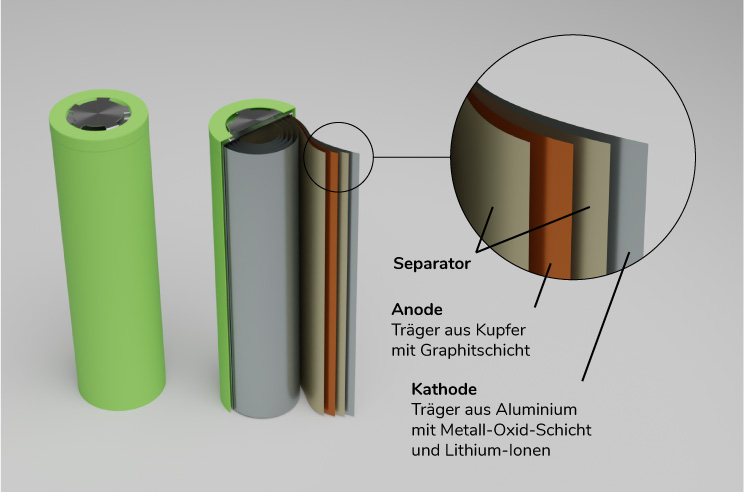
Most modern batteries use what are known as NMC cylindrical cells.
NMC stands for:
NMC cells have become established because they offer a balanced combination of high energy density, a long service life and good safety.
Round cells have a relatively simple structure:
The cell winding itself essentially consists of three thin layers stacked on top of one another. A graphite-coated copper foil forms the negative terminal, also known as the anode. A microporous plastic film (polypropylene or polyethylene) acts as a separator between the positive and negative terminals and is wider than the two terminal layers to prevent short circuits. The positive terminal, an aluminium foil coated with lithium metal oxides (NMC or LFP), serves as the cathode.
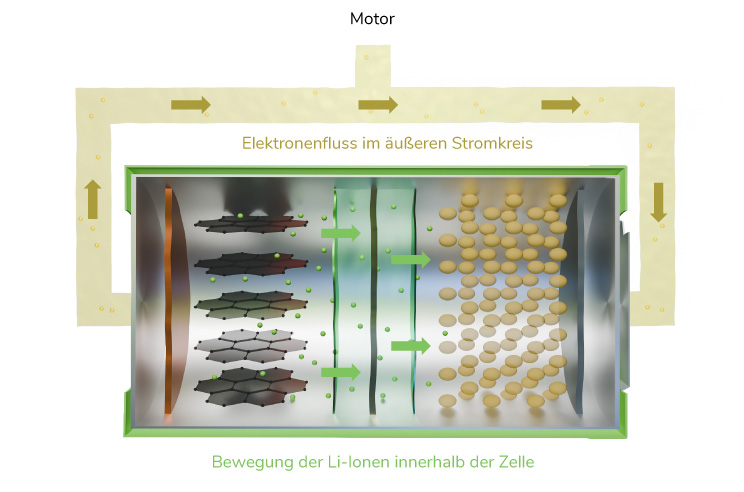
The cathode is the source of the lithium ions. During charging, the lithium ions leave the cathode and travel through the separator to the anode. During discharging, they return.
The opposite side of the cathode is the anode, which is usually made of graphite, a special form of carbon.
Graphite has a layered structure. During charging, lithium ions can be inserted between these layers. This process is known as intercalation.
The anode and the graphite it contains serve as a storage site for the lithium ions whilst the battery is charged.
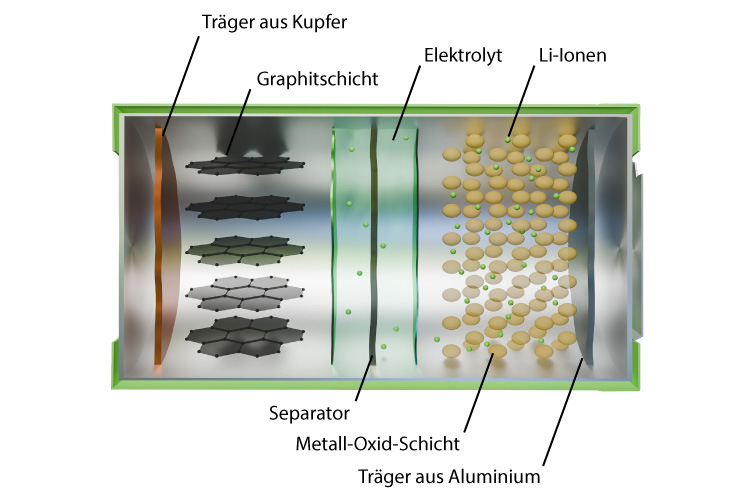
To put it figuratively, graphite can be thought of as a car park for cars – a three-dimensional structure with parking spaces for lithium-ion particles. If all the parking spaces are occupied, the battery is fully charged; if all the parking spaces are free, no more electrical energy can be drawn from the battery.
The separator is located between the anode and the cathode. This thin plastic membrane has several key functions:
To enable the lithium ions to move between the anode and the cathode, a special liquid – the electrolyte – connects the layers. This liquid is electrically conductive and can transport lithium ions during charging and discharging.
When the battery is connected to the charger, electrical energy is supplied from an external source.
Several processes take place simultaneously:
1. Lithium-ion leaves the cathode.
2. The ions move through the electrolyte.
3. They are deposited within the graphite structure of the anode.
4. The associated electrons flow via the external circuit to the anode.
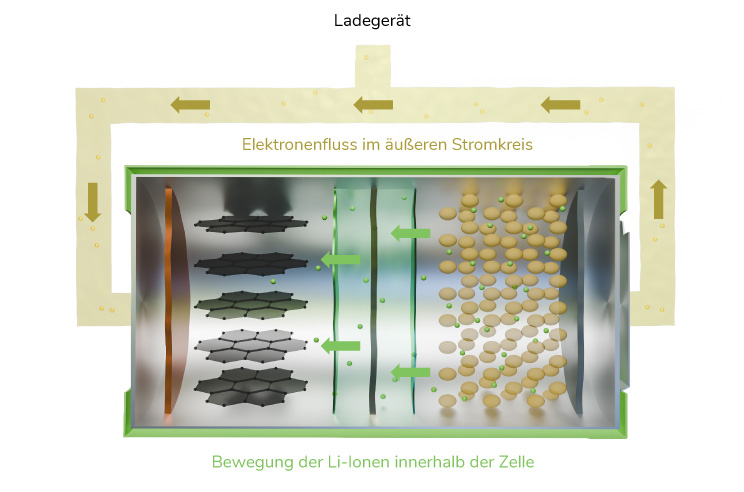
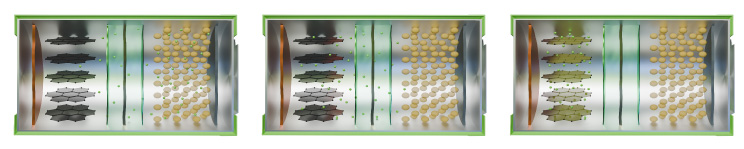
This converts electrical energy into chemical energy, which is then stored in this form.
You can think of this process as filling a reservoir: the more lithium ions are stored in the anode, the higher the cell’s state of charge.
The battery discharges during use, so the process runs in the opposite direction.
The lithium ions leave the anode and travel through the electrolyte back to the cathode.
At the same time, electrons flow through the wires to the consumer via the external circuit.
This flow of electrons is the electric current that ultimately powers the device.
This loss of capacity is a natural ageing process and cannot be completely prevented in lithium-ion batteries. The main causes lie in the chemical changes taking place within the cells.
The SEI layer
A protective layer forms on the surface of the anode as early as the first charging cycle.
This so-called SEI layer (Solid Electrolyte Interphase) is formed as a result of reactions between the electrolyte and the anode surface. The layer is generally desirable because it protects the anode and contributes to the stability of the cell.
In the process, free Li ions are also firmly incorporated into the metallic structure and are therefore no longer available.
The CEI layer
A boundary layer also forms on the surface of the cathode; this is known as the CEI layer (Cathode Electrolyte Interphase).
Over time, both layers continue to grow.
Their formation consumes lithium ions, which are subsequently no longer available for energy storage. This reduces the cell’s usable capacity.
Ageing of the electrodes
As the number of charge cycles increases, slight changes may occur in the material, causing the mobility of the lithium ions within the cell to deteriorate.
The so-called internal resistance increases, whilst capacity and performance gradually decrease.
The ageing of a lithium-ion cell depends not only on the number of charge cycles, but also on the operating conditions.
The following are particularly stressful:
Lithium-ion technology now enables high-performance, long-lasting e-bike batteries. Energy is stored and released through the movement of lithium ions between the anode and cathode.
Although every cell ages over the course of its life, modern NMC cells can achieve several hundred to well over a thousand charge cycles. Their service life can be further extended through proper use, moderate temperatures and suitable storage.